
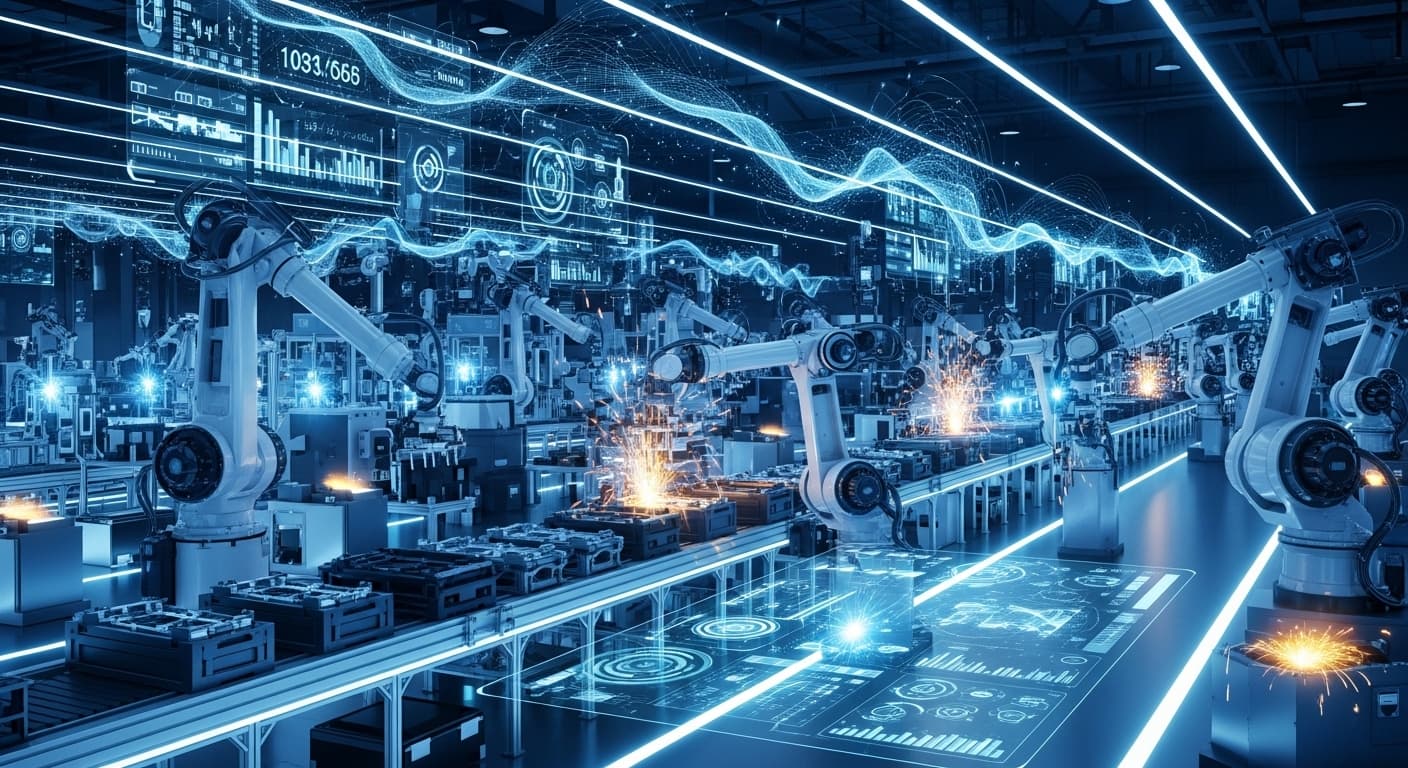
Manufacturing operations run on precision and timing. A delay at one stage ripples through the entire production line. A missed supplier alert becomes a shutdown. A manual data entry error becomes a quality failure three steps downstream.
AI agencies — teams that design, build, and deploy AI-powered automation workflows — are now working directly with manufacturers to close the gaps that have existed for decades: the human bottlenecks, the disconnected systems, and the reactive fire-fighting that consumes operations teams.
Here's what that looks like in practice, and where it's delivering the most measurable impact.
The Manufacturing Problem AI Is Actually Solving
Before getting into solutions, it's worth being specific about the actual problems. Manufacturing delays and manual work aren't a single problem — they're a cluster of inefficiencies that compound each other.
The most common sources of avoidable delay:
- Manual production reporting — operators logging output, downtime, and defects by hand, hours after the fact
- Reactive maintenance — equipment failures discovered after they happen, not before
- Supplier communication gaps — purchase orders, delivery confirmations, and delay notifications handled over email with no automated tracking
- Quality inspection backlogs — human inspectors as a bottleneck in high-volume lines
- Approval chains that don't move — change orders, work orders, and procurement requests sitting in inboxes waiting for human sign-off
- Disconnected systems — ERP, MES, WMS, and supplier portals that don't talk to each other, requiring humans to manually transfer data between them
Each of these is a solvable problem. AI agencies aren't replacing the entire factory — they're eliminating the specific handoffs and bottlenecks where manual work creates the most drag.
Where AI Agencies Are Deploying Automation in Manufacturing
1. Production Monitoring and Real-Time Alerting
Traditional production monitoring means someone checks the dashboard every few hours — or waits for an end-of-shift report. By the time a problem is visible, it's already caused an hour of lost output.
AI agents monitor production data continuously. When output drops below threshold, cycle time increases beyond normal variance, or a machine starts showing anomalous readings — the agent flags it immediately and routes the alert to the right person, not just a generic inbox.
The practical impact: problems get caught in minutes, not hours. A line that would have lost a full shift to a slow-developing fault is now caught and corrected in the same hour.
💡 Tip
The key distinction here is routing intelligence. A basic alert system sends a notification to everyone. An AI agent assesses the alert type, severity, and context — and sends it only to the person who can act on it, with the relevant data attached.
2. Predictive Maintenance Scheduling
Reactive maintenance — fixing equipment after it breaks — is one of the most expensive operating patterns in manufacturing. Unplanned downtime costs manufacturers an estimated 5–20% of productive capacity annually.
AI agencies deploy predictive maintenance models that analyse:
- Vibration and temperature sensor data from equipment
- Historical failure patterns for each machine type
- Current operating load and cycle frequency
- Manufacturer maintenance schedules vs. actual usage
The model flags equipment that is statistically likely to fail within a defined window — before it fails. Maintenance is scheduled proactively, during planned downtime, not in response to a breakdown.
Real outcome: A mid-size automotive parts manufacturer implementing predictive maintenance AI reduced unplanned downtime by 35% in the first six months. The maintenance team went from reactive firefighting to scheduled, planned work.
3. Automating Supplier Communication and Order Tracking
Procurement and supply chain teams spend significant portions of their day sending, receiving, and chasing emails — purchase order confirmations, delivery ETAs, delay notifications, invoice discrepancies.
AI agents can handle the entire routine communication layer:
- Auto-generate and send purchase orders based on inventory triggers
- Monitor supplier responses and flag non-confirmations after a defined window
- Track delivery ETAs against production schedules and alert when a delay creates a downstream risk
- Auto-escalate supplier issues that haven't been resolved within SLA
- Reconcile invoices against purchase orders and flag discrepancies for human review
The procurement team stops spending time on status-chasing and starts spending time on supplier relationships and strategic sourcing decisions.
ℹ️ Info
AI agents handling supplier communication don't replace relationships — they remove the administrative overhead so procurement teams can focus on the conversations that actually require judgement and relationship management.
4. Automated Quality Control Data Collection
Manual quality inspection creates two problems: it's a bottleneck in high-volume lines, and it produces inconsistent data because different inspectors notice different things.
AI-assisted quality control takes two forms:
Computer vision for defect detection: Cameras on the line analysing every unit against a trained model. Defect detection rates that exceed human inspection in speed and consistency, with every rejection logged automatically with the defect type, location, and production context.
AI-assisted data collection: For inspections that still require human judgement, AI agents guide the inspector through a structured checklist, capture the data automatically, and flag any result that falls outside acceptable variance — no paper forms, no manual data entry, no transcription errors.
Both approaches produce a complete, accurate, real-time quality record — which feeds back into process improvement decisions and supplier quality tracking.
5. Intelligent Work Order and Approval Routing
Change orders, maintenance work orders, and production modification approvals are frequently cited by operations teams as one of the biggest sources of delay. A work order that needs three approvals might sit in inboxes for 48 hours — not because the approvers are unavailable, but because routing is manual and reminders are someone's job.
AI agents handle this automatically:
- Work orders are routed to the correct approver based on type, value, and urgency — instantly
- Approvers get structured notifications with all relevant context attached — not just "please review"
- Escalation is automatic if an approval isn't completed within the defined SLA
- Completed approvals trigger the next step in the workflow without human handoff
The result: approval cycles that previously took 2–3 days collapse to hours. Operations teams stop managing the process and start managing exceptions.
6. ERP and System Integration Agents
Most manufacturers have data in multiple systems — an ERP for financials and inventory, an MES for production, a WMS for warehouse, and separate portals for each major supplier. Keeping these in sync requires humans to manually transfer data between them.
AI agencies deploy integration agents that act as the connective tissue between these systems:
- Production completions in the MES automatically update inventory in the ERP
- Sales orders automatically trigger production scheduling based on current capacity
- Shipping confirmations from the WMS update customer-facing order status automatically
- Supplier delivery data updates production schedules in real time
This eliminates entire categories of manual data entry — and the errors that come with it.
What an AI Agency Actually Does (vs. Off-the-Shelf Software)
This distinction matters. Off-the-shelf automation software (your ERP's built-in workflows, standard RPA tools) handles predictable, static processes. It breaks when anything falls outside the defined pattern.
An AI agency builds intelligent agents that:
- Understand context — they can interpret an ambiguous supplier message, assess whether a sensor reading is truly anomalous or normal variance, and make routing decisions based on situational factors
- Handle exceptions — when something falls outside the standard pattern, the agent assesses the situation and either handles it or escalates with a clear summary, rather than silently failing or requiring manual intervention
- Learn from outcomes — agents can be updated based on feedback from the operations team, improving accuracy over time
- Integrate across systems — rather than requiring a single unified platform, agents act as the connective layer between existing systems
The practical difference: standard automation automates what already works. AI agents fix the parts that don't.
Measuring the Impact
Manufacturers who have deployed AI agency solutions report consistent improvements in specific measurable areas:
| Area | Typical Improvement |
|---|---|
| Unplanned downtime | 25–40% reduction |
| Manual data entry hours | 60–80% reduction |
| Approval cycle time | 50–70% reduction |
| Supplier delay detection | Same-day vs. next-day |
| Quality inspection throughput | 2–5x increase with computer vision |
| Procurement admin time | 40–60% reduction |
These numbers vary significantly based on starting point, implementation quality, and which processes are automated first. The highest ROI consistently comes from targeting the highest-frequency, highest-delay manual processes first.
Where to Start
The manufacturers who get the fastest results from AI automation don't try to automate everything at once. They identify the two or three manual processes that create the most delay or consume the most operator time — and automate those first.
The questions worth asking before any AI agency engagement:
- Where do things get stuck? Which handoffs between teams, systems, or people create the most delay?
- What gets done manually that produces data? Any manual data entry process is an automation candidate.
- What do your operators complain about most? Front-line staff have precise visibility into where time is wasted.
- What breaks when someone is absent? Processes that depend on a specific person's attention are high-priority automation candidates.
Start with the answers to those four questions. That's your automation roadmap.
Manufacturing operations have been living with these inefficiencies for so long that many teams assume they're just the cost of doing business. They're not. They're the cost of not having the right automation layer in place.
If you're building AI workflows for manufacturing operations and want to make sure they're built securely and reliably — with proper monitoring, fallback paths, and no silent failure points — see the AI automation packages or get in touch.
Tags