
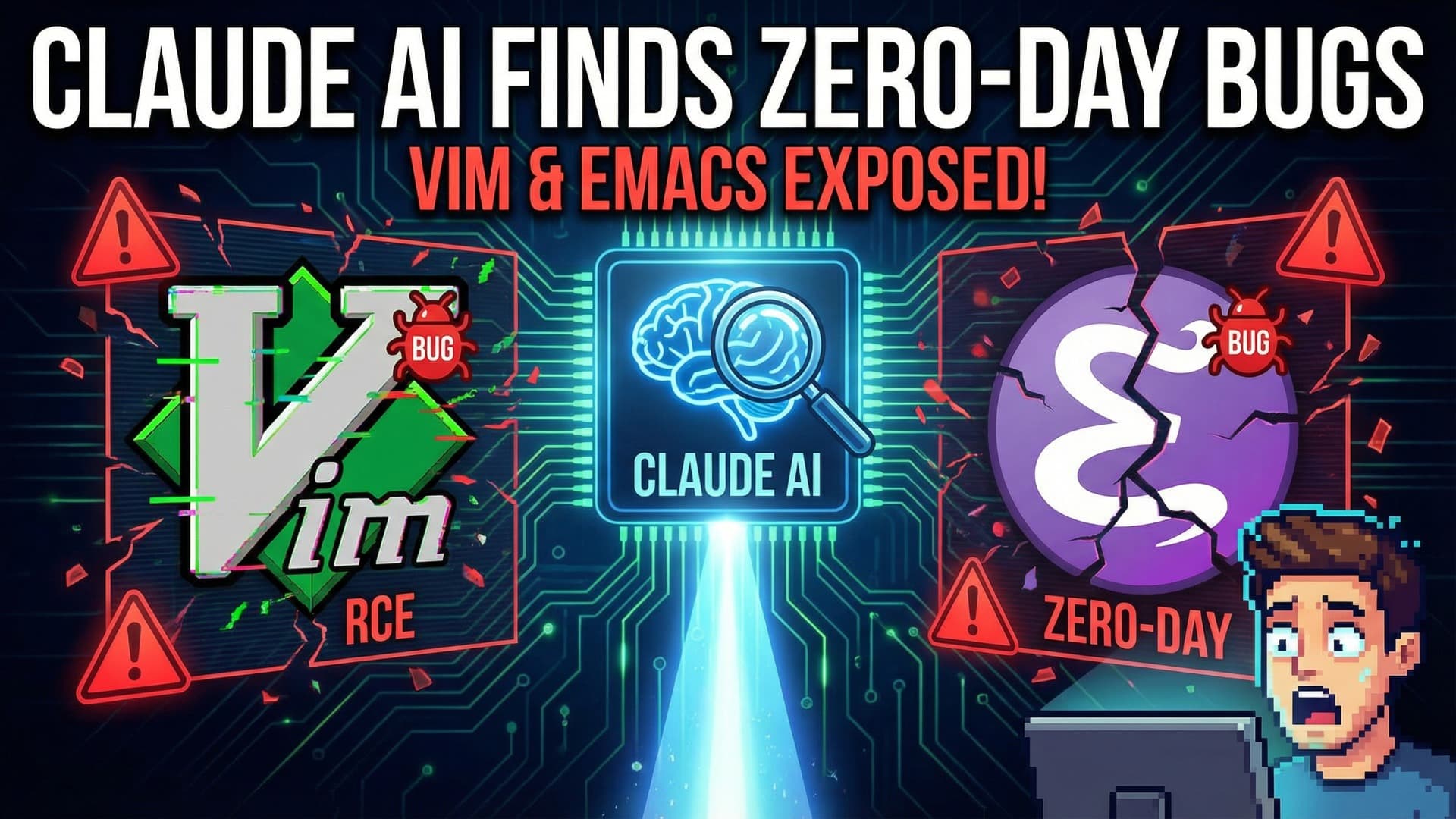
A security research team gave Claude a single prompt:
"Somebody told me there is an RCE 0-day when you open a file. Find it."
Claude found it. In Vim 9.2. Opening a specially crafted markdown file would execute arbitrary code on your machine. No interaction required beyond opening the file.
Then they asked Claude to find the same kind of flaw in GNU Emacs. It found one there too.
The Vim team patched it within hours of responsible disclosure. The Emacs maintainers looked at the same report and responded: "This is a Git problem, not our problem." Left it unfixed.
That's the full story. And it should make every business owner, CTO, and developer uncomfortable for reasons that go way beyond text editors.
What the Vulnerability Actually Does
The Vim RCE (tracked as GHSA-2gmj-rpqf-pxvh) works by embedding malicious code inside a markdown file in a way that Vim processes automatically when you open it. No :source ~/.vimrc. No explicit command execution. Just vim malicious.md and the payload runs.
The Emacs vulnerability is similar in principle but different in trigger — the victim opens a text file from a compressed archive, and a background payload executes silently. Both require no advanced social engineering beyond getting someone to open a file from an untrusted source.
For most users, the advice is straightforward: don't open files from untrusted sources. But that's cold comfort in environments where:
- Developers routinely open files from email attachments, Slack downloads, and vendor-provided "patch" scripts
- CI/CD pipelines process files from third-party repositories
- Support teams receive logs and configs from客户的 systems
- Any system that handles markdown, documentation, or text files is in scope
If you're running Vim 9.2, upgrade to 9.2.0172 immediately. That's the patched version. If you're running Emacs and waiting for a patch — keep waiting, or switch to a different editor.
Why the Emacs Response Is the Real Story
The vulnerability disclosure to the Emacs team produced what might be the most jaw-dropping security response in recent memory. The maintainers reviewed the RCE exploit, acknowledged the behavior, and then attributed it to Git — specifically, to how Git handles certain file operations — rather than to Emacs itself.
This is a fascinating example of the gap between "technically correct" and "actually secure."
Is it technically accurate that the payload delivery mechanism involves Git behavior? Maybe, in a narrow sense. Does that mean Emacs users aren't at risk from a working RCE exploit floating around the internet? Absolutely not.
The researchers noted this left Emacs users in a precarious position with no official mitigation. An unpatched zero-day RCE in a widely-used text editor is a real threat regardless of where you assign blame in the causal chain.
What this tells you practically: if you're running Emacs in a security-sensitive environment, you need to evaluate your own mitigation controls. You can't rely on upstream patching to be your safety net.
Why This Is Different From Normal Bug Bounty Findings
Bug bounty programs have been finding vulnerabilities in software for two decades. This isn't new. What's different is how these were found — and what that implies.
Traditional vulnerability research requires:
- Deep reverse engineering skills
- Fuzzing infrastructure
- Deep knowledge of specific software internals
- Months or years of experience in a specific area
What Claude needed for this finding:
- A plain English prompt
- Access to the codebase (or equivalent training data)
- No special tooling, no custom infrastructure, no 0-day research expertise
The AI didn't just assist the researchers. It was the researcher. The team described it as the kind of discovery that would have required significant expertise and time using traditional methods — collapsed into a single natural language interaction.
This is the bug bounty dynamic that nobody in security is fully prepared for: the cost of finding vulnerabilities has collapsed. Which means the incentive structure for both attackers and defenders has fundamentally shifted.
What AI-Assisted Vulnerability Discovery Actually Means for Your Business
Here is the uncomfortable part.
If an AI can find a zero-day RCE in Vim with a simple prompt, the same capability exists for every piece of software your business depends on. Not in some future sense — today. The question is whether anyone with less benign intent has already asked the right questions of the right AI systems.
Attackers don't need to hire experienced vulnerability researchers anymore. They need to know how to prompt an AI effectively. That's a much lower barrier to entry.
On the defensive side, the same capability is available to your security team. You can use AI to audit your own code, your dependencies, your configuration choices — not instead of a real security review, but as a first pass that surfaces obvious issues faster.
The researchers announced "MAD Bugs: Month of AI-Discovered Bugs" running through April 2026 — a planned series of AI-discovered vulnerabilities being published publicly. Every disclosure in that series is a reminder that:
- Your software stack has likely never been audited this thoroughly
- Vulnerabilities are being found faster than they're being patched
- Your attack surface includes not just your code, but every tool your developers use
The Practical Takeaways for Businesses
Patch Vim immediately. If your developers use Vim, upgrade to 9.2.0172. This is a real RCE, not theoretical.
Reassess how your team opens files. Opening files from untrusted sources is a known risk, but AI-generated exploits raise the quality and believability of malicious files. Someone sending you a "patch notes" markdown file may genuinely not know it contains an exploit.
Don't rely on upstream being responsible. The Emacs response is extreme but not unique. Many open source projects have limited security resources. Assuming "someone else is on top of this" is not a security posture.
Use AI for your own security audits. Not instead of a real penetration tester, but as a preliminary scan of your own codebase, your configuration choices, your dependency vulnerabilities. This is a legitimate use case for the same capability that found these vulnerabilities.
AI security is now a first-class concern. Every business integrating AI agents into their development workflow, their CI/CD pipeline, their code review process — is now also inheriting the security posture of those AI tools. What data do they have access to? What can they execute? Who can prompt them?
The short version. An AI found a real zero-day in a widely-used piece of software with one prompt. The maintainers' response ranged from "patched immediately" (Vim) to "that's a Git problem" (Emacs). The lesson isn't just about text editors.
The lesson is that vulnerability discovery has been democratized. Your threats have access to the same capability. Whether your defenses do — that's a decision you should be making now, not after your first incident.
Upgrade your Vim. Audit your toolchain. And assume AI-discovered vulnerabilities in your stack are being actively looked for — by someone.
Tags